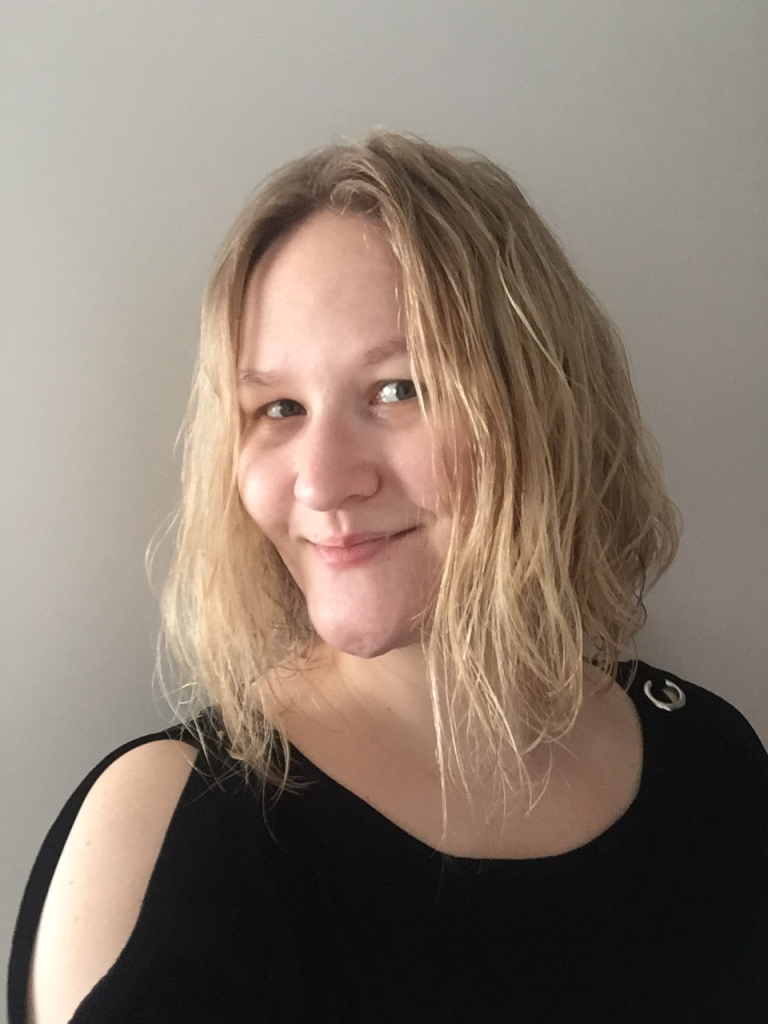
Interview with Josefine Atzendorf
MPI for Social Law and Social Politics
Soapbox: Did you choose a scientific career or did the scientific career choose you?
Josefine Atzendorf: The scientific career has definitely chosen me. Before I started to study at the university, I wanted to become a psychotherapist. However, I’ve always found the Sociology lectures very interesting too, so I have kept studying Sociology and Psychology. During my studies I really had to dig myself into statistics and data analysis, because Sociology and Psychology are both subjects with a strong empirical background. I discovered that it really can be fun to work with data once I got the hang of it. After the university I knew that I wanted to continue to work with data and do data analysis and therefore I decided to do a PhD. I was very lucky that I had the possibility to work on many publications right from the beginning of my PhD, because the project I was working on produced so much data. A scientific career was never my goal; the goal always has been to do data science.
SB: What was the key moment that brought you to the place where you are today?
JA: I think a key moment for me was when I discovered the book “Discovering Statistics by Using IBM SPSS Statistics” by Andy Field. If it would not have been for its great explanations and the fun examples and exercises, I am not sure if I would have fallen in love with data science.
SB: What is your scientific superhero power? Or what superhero would you be?
JA: My scientific superhero power would be persistence. I am always striving for the feeling of solving an issue. This is how I learn best. The counter side is that nothing frustrates me more than not being able of solving an issue. In these cases, I sometimes would like to become the Hulk (just for a few seconds).
SB: What is the most exciting aspect of your research?
JA: I love to learn new things. Right now, I am doing database management for a very large study (SHARE) with about 140.000 respondents and it is very excited to learn how to handle data with a size that big. Of course, the possibility of answering research questions with a dataset like that also excites me. One strength of the survey is also that we can do comparisons between different countries in Europe.
SB: If you were stranded on a desert island, what scientific equipment would you bring with you?
JA: In my case the answer is probably very boring, but I would bring a laptop with my
statistical programs on it and as long as I have WIFI, I actually could work from
anywhere.
SB: What challenges do you encounter in science?
JA: There are endless challenges. For example, in data cleaning it is challenging to decide which data needs to be “cleaned” or if you correct data after all. Before you have data, it is also challenging to construct a survey. Right now, I have been seeing many surveys spreading around trying to assess how people live during the Corona pandemic. Some of them are only online surveys and are often being disseminated on social media platforms. In this case it is very unlikely to get a representative sample, because people who are not using these social media platforms will not have the same chance to answer the questionnaire like people who are using these platforms. That is always a big challenge with online surveys.
SB: What motivates you to give a talk in Soapbox Science?
JA: I am loving to share my research with a broader audience, which you usually will not find at scientific conferences. I am a big fan of open science and I like to idea of making research more accessible to everyone.
SB: Do you have a few words to inspire other women or young scientists?
JA: Set your own limits.
There will always be people who think they know what is best for you and what you can do and what you cannot. Decide for yourself what and where your limits are. It is your life after all.
SB: In these quarantine days, what funny/interesting experiments, books, talks or podcast can you recommend to our audience?
JA: I have been working on many projects during my quarantined home office days. One experiment me and my friends are doing is that each of us is trying to raise an avocado plant. We used avocados from different stores (normal supermarket, organic grocery store). So far, we have one avocado which put on some mold, but already popped up, and two avocados which do not do anything. I am also doing a psychological experiment and I am writing three things I am thankful for in a diary each day. This way I am trying to train my perception to look for positive things and not being overwhelmed by the negative news these days.
You can connect with Josefine on ResearchGate.
 Soapbox Science Munich