Interview with Dr. Katrin Kappler
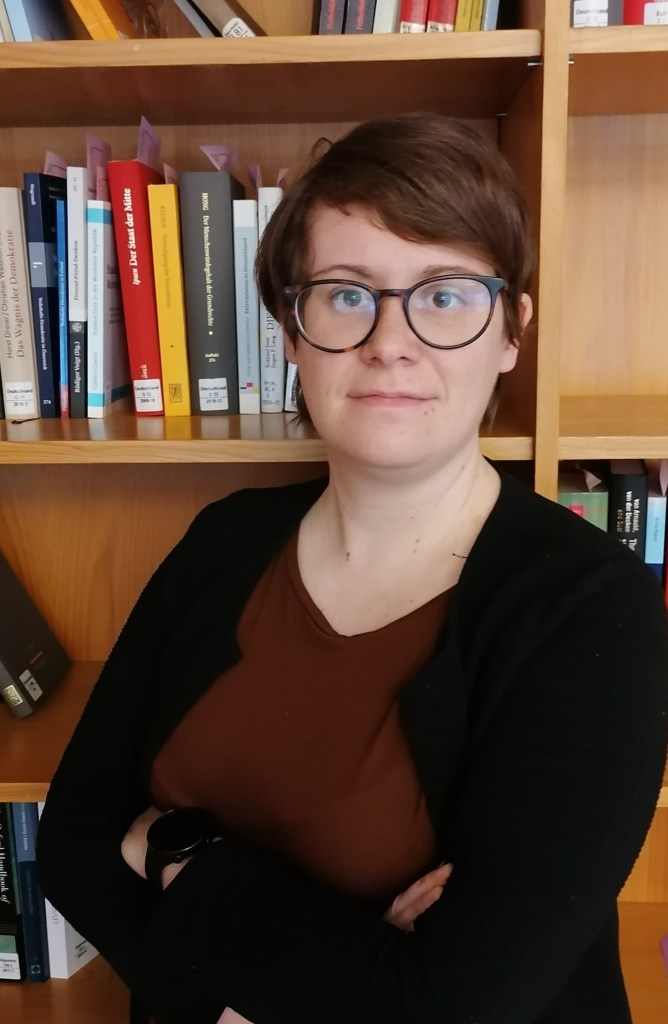
Postdoctoral researcher at the MPI-CSL
Soapbox: Did you choose a scientific career or did the scientific career choose you?
Katrin Kappler: That is a very interesting question. During my studies, I never thought about working in science. In law school, we are mainly trained to become judges, prosecutors or lawyers. The only exception is that shortly before our final exams we write a seminar paper – this means working scientifically for the first time. I enjoyed that so much that I chose to write a PhD thesis afterwards. And again, I enjoyed that so much that I wanted to go into science afterwards. That’s probably why science rather chose me.
SB: What was the key moment that brought you to the place where you are today?
KK: I made the decision to continue working in academia over several years. Therefore, it is not so easy to identify the one moment that brought me here. But a central moment/a central experience was the disputation, i.e. the oral examination of my doctoral thesis, which I greatly enjoyed and which showed me that it is fun to write about and discuss topics that matter to me.
SB: What is your scientific superhero power? Or what superhero would you be?
KK: I wouldn’t call it superhero-power. And I don’t think you need one in science. But what I am really good at – like many other scientists probably are – is simplifying, systematizing and clarifying complex issues. In all phases of my academic career, perseverance was incredibly important. The study program takes a long time and especially the exam preparation at the end of the study, which takes a year, is mentally exhausting. It is not always easy to work in academia either, e.g. when abstracts are rejected. Enthusiasm for one’s own academic work is particularly important during those times.
SB: What is the most exciting aspect of your research?
KK: The most exciting aspect of my research is that I can show that law and politics do not function independently, but are dependent on each other. This is obviously true in the legislative process, because legislative initiatives regularly come from the government. But even when a law is in force, there is sometimes room for political decision-making. This applies, for example, to the ban of political parties: even if a party is unconstitutional, the government is not obliged to initiate party banning proceedings. Rather, it can also decide to seek political discourse.
SB: If you were stranded on a desert island, what scientific equipment would you bring with you?
KK: As a legal scholar, I am desperately in need of two things: My computer and books. Books are said to be the laboratory of law scholars. My daily routine consists of analyzing laws, considering other academic research and, in the end, working out my own opinion. To avoid my suitcase becoming too heavy, I would scan as many academic papers as possible and take my tablet with me so that I can read the papers on it.
SB: What challenges do you encounter in science?
KK: The biggest challenges are uncertainty and fixed-term contracts. In some cases, an academic career is also possible at research institutes such as the Max Planck Institute, where I am currently doing research. There you have also a possibility of a permanent position. But the majority of legal researchers only have the option of a professorship at a university. On this path to a professorship, however, it is difficult to foresee which professorships with which focus will become available at what time and whether I will be selected
SB: What motivates you to give a talk in Soapbox Science?
KK: I applied for two main reasons: First, I want to encourage young women to consider a career in science. The number of women in law is admittedly higher than in some other branches of science. Nevertheless, it also decreases the further one progresses: At the PhD level, the number is still more or less balanced, but this is no longer the case for post-docs and even less so at the level of professors. We can only change that together.
In addition, I would also like to make legal sciences more public. When you think of science, law is maybe not the first thing you think of. That is why it is important to draw attention to the task of legal scholars. The core of my academic work is to show how extremism can be combated through law, but also what the legal limits are.
SB: Do you have a few words to inspire other women or young scientists?
KK: The world is full of opportunities, paving way for more and more fascinating research in various fields of science. Identify where your passion lies and start working towards your goals with determination. Don’t let the society define your roles based on the gender. Together we can create a better tomorrow ☺

Postdoctoral researcher at the MPI-CSL
SB: Do you have a few words to inspire other women or young scientists?
KK: The most important and valuable moments during my academic career so far have always been those when I didn’t pretend and wasn’t under pressure to pretend anything. It may sound trivial, but I would therefore encourage all women and young scientists not to pretend to be something they are not or are not comfortable with and to work on the topics that matter to them.
You can connect with Katrin on Twitter.
 Soapbox Science Munich