Lasers for Life by Dr. Nathalie Nagl
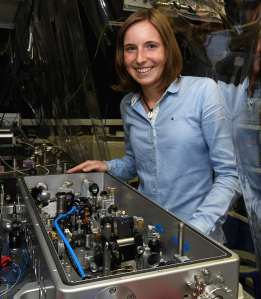
Postdoctoral researcher at the MPQ
Imagine, you visit a doctor and donate a little drop of your blood. With the help of a laser, the doctor could then analyze it within minutes and diagnose severe diseases at the earliest possible stage. Wouldn’t that be amazing?
Before I tell you more about laser physics, let me introduce myself first. I am Nathalie, 27 years old, and my home is in one of the most beautiful regions in Germany: Bavaria. With its lofty mountains and serene mirror-like lakes as big as seas, it offers a perfect change from the daily work routine. As a passionate scuba diver, I love to discover new places underwater, whether it is during hot summer or icy winter season. When I go diving, it feels like going on an adventure: most of the time, you actually do not know what to expect in the deep and dark water. These adventures, sadly, will always remain hidden for most of the people, and it is only my words that can shed light onto them. To a great extent, this also relates to my passion about laser physics! At first glance, it may sound odd, but I feel that it provides a strong link between my private and professional life. Let me explain why.
Physics is a very broad field of science, encompassing investigations on the smallest particles and observations of stars and galaxies light-years away. Though this sounds quite fascinating, one should have a certain affinity for mathematical formulae to understand the underlying theoretical framework — and this is also true for laser physics. However, to share my excitement about it and catch other people’s attention, I only use my words to talk about it. And that is why I participate as a Soapbox Science speaker!

Fig. 1: What do scuba diving and laser physics have in common? It is the new things and “adventures” that are waiting to be explored!

Being a physicist feels like being part of a very small community, just as scuba divers feel compared to other sports like soccer or tennis. But, isn’t it great to do something special and report about it? Yes, of course! Funnily, I have chosen a hobby and a profession in which one is (a) surrounded mostly by male colleagues and (b) with which many people have a hard time understanding what you are really doing and why; it might sound a bit crazy to go diving in a cold lake in Germany – where the chance is minimal to see even a single fish underwater. The same is also true for my daily work in a research facility, where one can spend hours trying out something new – even though the success rate might be hard to estimate. But, if nobody dares to push ahead and explore the unknown, there will be no adventures to report in the future!
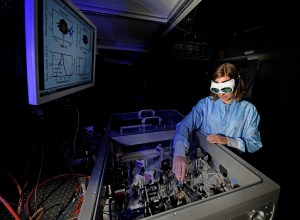
For me as a physicist, it is not only a chance to learn something for life, but also to help other people to live a better life. And this is the idea behind my research project: Lasers for Life. Compared to other sources of light, lasers produce a very special light in the form of a beam. This is one of the reasons why laser pointers have become so popular nowadays: you can use them to highlight very specific points without illuminating the surroundings. But, compared to the visible beam coming out of a laser pointer, the type of laser I am working with produces infrared light that you cannot see. Honestly, this makes it quite tricky to work with. However, this is what is needed for a broad range of applications because infrared light causes molecules to vibrate. And by analyzing these vibrational signals, we can learn a lot about the health status of a person!
Apart from the infrared color, another special characteristic of my laser is that its output is not continuous but pulsed. This is advantageous in many respects because you can apply some magic tricks! A very popular one is to create new colors of light (or wavelengths) since most applications require different colors to work with. But it is not only about the color. They also require laser systems that are compact and generate a laser beam with low fluctuations. Imagine wanting to listen to a very quiet signal, but you cannot hear anything because the surroundings are too noisy. This is like using a laser beam with fluctuating power for applications. Luckily, we came up with a solution on that and this is what makes our laser systems so special!
Fig. 2: Lasers for sensing disease markers in human blood. Find out more on our website!

So how can a laser be used to improve people’s live? Coming back to the appointment at the doctor: if you donate only a little drop of blood and the doctor can analyze it with the help of a laser system, diseases like cancers could then be detected at a very early stage already. At such an early stage, medical therapy could prevent you from developing severe illness. And it only costs you a few minutes of your life! Doesn’t it sound amazing? And this is exactly what I am working for:
Developing Lasers for Life.
Postdoctoral researcher at the MPQ
 Soapbox Science Munich