Children of the Bosnian Diaspora: how Gratitude is making me a better researcher by Enisa Smlatic
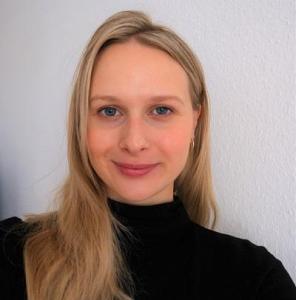
PhD student at the LMU
What or who gives you the strength to believe that you are able to achieve something in life?
When I was younger, my family and I travelled every year to Bosnia for the summer holidays. Overall, I have good memories of those times as a child: playing outdoors all day and every day with my cousins, surrounded by the lush green mountains in the countryside, not a care in the world, no internet, often no electricity and drinking water, (well, you would have to work for that), the beautiful nature and the hospitality of its people. But then of course there were the questions of me and my brother to our Belgian mother: “Mama why are there so many holes in the walls of this house? Why can’t we go play in that forest? Why is this man missing a leg? Why is our cousin so small and skinny? Where is their mother?” She would on her turn reply with an answer that is both logic and satisfying to children our age and then we would simply resume playing.
However, I am not here to talk about what the war has brought to my family and the poor region where my family is from. I want to talk to you about my own experience of how our background shapes what we think we can or are supposed to be doing in life.
This summer will mark eight years that I have not visited Bosnia.
Why? My brother says that I think I am ‘too good’ for them. This is untrue. Anyhow, I had to figure out for many years what the reason was behind “I do not not feel like going there”. And after much reflection I realise that this is a consequence of a profound feeling of guilt and shame. The ones that got away. As I got older and had enrolled in university, I came to realisation how different my life had become compared to the friends and cousins that had been left behind. I came to realisation that the dreams we talked about as children under the cooling grape vines about traveling the world and becoming a doctor or a lawyer were just a fantasy, at least they were so, for them. A lost generation. Being born and raised in Belgium I was overwhelmed with the opportunities I was being offered and at the same time I was very much saddened by the unfairness of life. My childhood friends in Bosnia soon became young mothers and housewives, forever stuck there. So yeah, I felt ashamed of in a way, displaying my wealth of opportunity to them and simultaneously witnessing year after year so little socioeconomic progress in that country.
But what about the children of the diaspora?
I was a really good student. But I did struggle a lot. If I would run my finger over the list of students in a college group or go over names of authors on scientific papers, very rarely I would come across a Bosnian name (if any at all). In that rare event that my family proudly posted an achievement of a famous Bosnian person on social media, well, highly likely it would be a sportsman – or woman – in football or athletics (which is great of course). But in life sciences? Nobel Prize winner somewhere? Female PI of a world-renowned institute? No, not really (please do let me know if I missed out on anyone…). Not being able to have a Bosnian role model proved to be very challenging in a way that one starts to hesitate whether dreaming of doing a PhD and pursuing an ambitious and highly competitive career in the life sciences is actually something for Bosnian people. Sometimes I genuinely thought “should I even bother trying?” However, since I did not really have any living proof of someone that had succeeded before me and thus having no one to look up to, I had to trust myself. I decided to persevere, because I had to fully enjoy the many options I had growing up in a first world country, because I had to be feeling thankful to be having the freedom of choice of whatever it is that I want to do in life, despite the typical Balkan stereotype. When all those opportunities are being offered to us, we need to act on them and give back. Thanks to my family I am where I am today.
Why feeling guilty for opportunities that are being handed to you, when you should be feeling grateful instead!
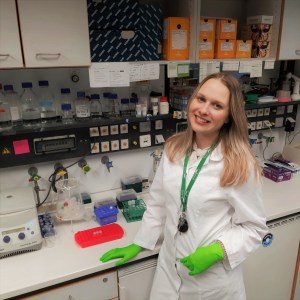
PhD student at the LMU
I learned that being grateful is key to success.
For years I have been looking for those Bosnians who were like me, eager to make a change through education, awareness and respect for our common history.
Fortunately, thanks to my move to Munich I am getting more and more in touch with long lost and forgotten young relatives who are like me, ambitious and ready to progress and overcome the stigma. Being able to relate to them and share the experience of being Bosnian while growing up in another country and dreaming of change is so reassuring and I wish this bond could have been established earlier in my life. Recently I have been in touch with organizations that are doing wonderful work on mentoring young Bosnian students and creating international relationships by reuniting the people that fled the country and essentially restoring a lost generation. This is so very necessary.
There is still a lot of work that needs to be done. We need to cherish our background but at the same time be able to detach from it so we can develop our own persona, strong and confident from a feeling of gratitude. It will be up to us to create the role models we couldn’t have ourselves.
You can connect with Enisa on LinkedIn.
 Soapbox Science Munich