Shapeshifters – slime molds from a physics perspective! by Lisa Schick, M.Sc.

Physics Departement, TUM
Hello World, my name is Lisa. I am a second-year graduate student working in the field of biological physics. This is my first time at Soapbox Science and to be honest, I am already a bit nervous. Will anyone be interested in what I have to say? And can I really talk about my research so that other people will be able to understand it? Can I find a way of showing what is fascinating me about my research in a simple way? And then again, I am really excited and looking forward to this awesome event that will help spread science into the world.
Talking to my non-biophysics friends, I often get asked, how I ended up doing biological physics. Even when talking to physicists or biologists, hardly anyone can relate to why working on the edge of both fields can be thriving and interesting. I believe the problem lies in the way, that the different fields approach science. But in the end, both biology and physics just want to explain the world. This is why I love biophysics so much. I enjoy the challenge of trying to pack biological behavior into physical equations.
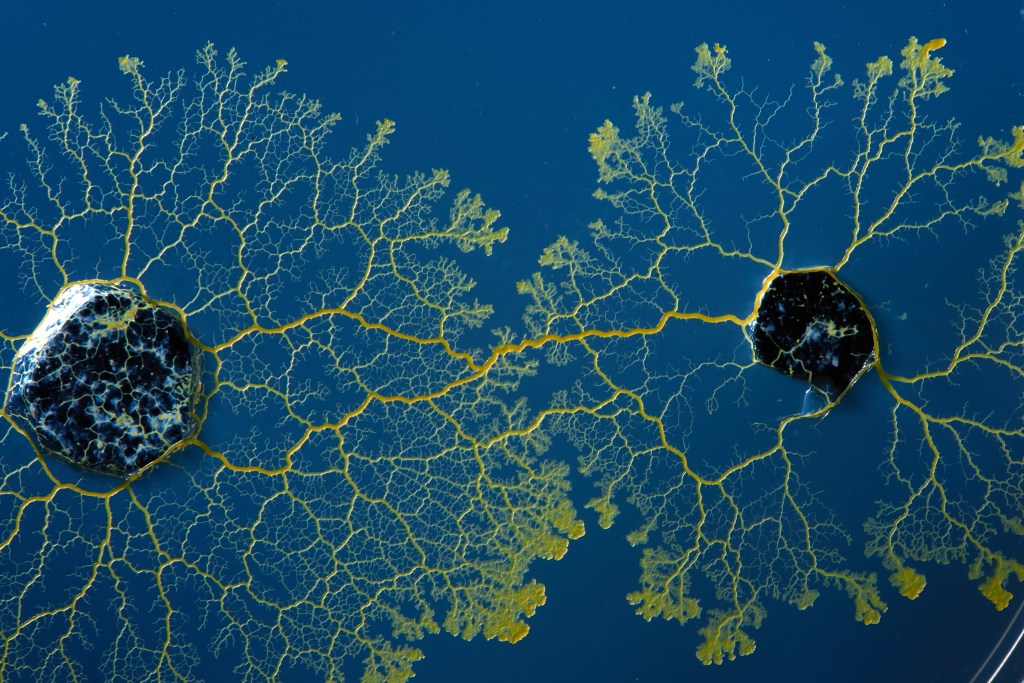
Credit: Wenzel Schürmann, TUM
So, what exactly am I working on? I guess that the title of my research focus is not really clear to anyone out there: Shapeshifters – slime molds from a physics perspective! I study slime molds. They are beautiful unicellular creatures that form really interesting network structures. Like us humans, they migrate to find food and move away from nasty habitats. While we humans do that by always looking the same, my little slime mold friend changes its shape. The network that it forms is reorganized every couple of minutes to hours while moving. This is already pretty interesting, but we do not understand exactly how and why our slime mold is doing, what it is doing. And here I come in. I put my slime mold under the microscope and take a video of it moving and then I try to find equations that explain how it can shapeshift.
Now you might ask, why is this interesting? Well, the slime molds that we keep in the lab are simple model organisms. If we can understand their behavior, we will be able to predict and understand the behavior of a lot more complex organisms like fungi networks. They build up the wood wide web. They connect trees and plants and help them communicate with each other. This underground communication path is a key player in predicting how climate changes affect our plant world. And since we know surprisingly little about how fungi, plants, etc., are influencing each other, we work with model systems like our slime mold to bring light into the dark soil region.
You can connect with Lisa on Twitter, Instagram, Facebook, or LinkedIn.
 Soapbox Science Munich