5 reasons why I love to be a scientist by Vanessa Luzak

Ludwig-Maximilians-Universität München
“Am I even allowed to call myself a scientist?“ was the first thought that came to my mind when I wrote down the title of this post. And then I asked myself: “What defines a scientist?“ Is it a bachelors degree, a PhD title (which I have not earned yet) or a professorship? I observed all the scientists around me at work, and quickly came to a conclusion: those degrees and titles are nice to have – but they do not define a scientist. What defines a scientist is the drive to come into the lab each day, even though none of the experiments in the previous weeks have worked, and try again and again to make them work. The curiosity to discover new concepts and, finally, to understand the world we are living in a bit better. This drive is not dampened by the financial and job insecurity we experience, not by long working hours and the strong impact on our private lives, as well as not by the strong impact on our mental health. You see, this drive can actually become damaging for a scientist– while it would take only a few realistic improvements of academic working conditions to relax this tense situation.
This article took a surprisingly negative turn, you might think, which was unexpected from the title. I did not address these points to shed a bad light on science, but rather because I care and I want to raise awareness that scientists need and deserve a fair amount of job security. However, let me now come to the positive aspects, the five reasons why I love to be a scientist and want to spend my life as such:
Reading
It is an important aspect of my job to stay informed about the latest research in my field. Therefore, I can spend a substantial amount of time reading and learning how life can be explained on the molecular level, which is absolutely fascinating.
Creativity
On the first glance, there might be little room for creativity in the structured scientific process. But when you zoom in, creativity is absolutely required when it comes to problem solving, data interpretation and the scientific writing process.
Low hierarchy
Although I am a PhD student, which is low in the hierarchy in academia, I still have the responsibility for my project and can strongly shape its direction. In scientific discussions, I do not have to consider my hierarchical position, but can express my opinion instead, even if it contradicts the opinion of my supervising professor. To me, this seems to be a kind of freedom that is rare in working environments.
International work environment
I am working as a scientist in my home country Germany, and still, most of my colleagues come from different places in the world. Diverse backgrounds are part of my daily life, and I enjoy it immensely to learn every day about food, politics and cultures in different parts of the world.
Traveling
Last, but not least, it is my favorite part that I can travel the world to visit conferences, to engage in discussions with international colleagues and to build a network of friends all over the world.
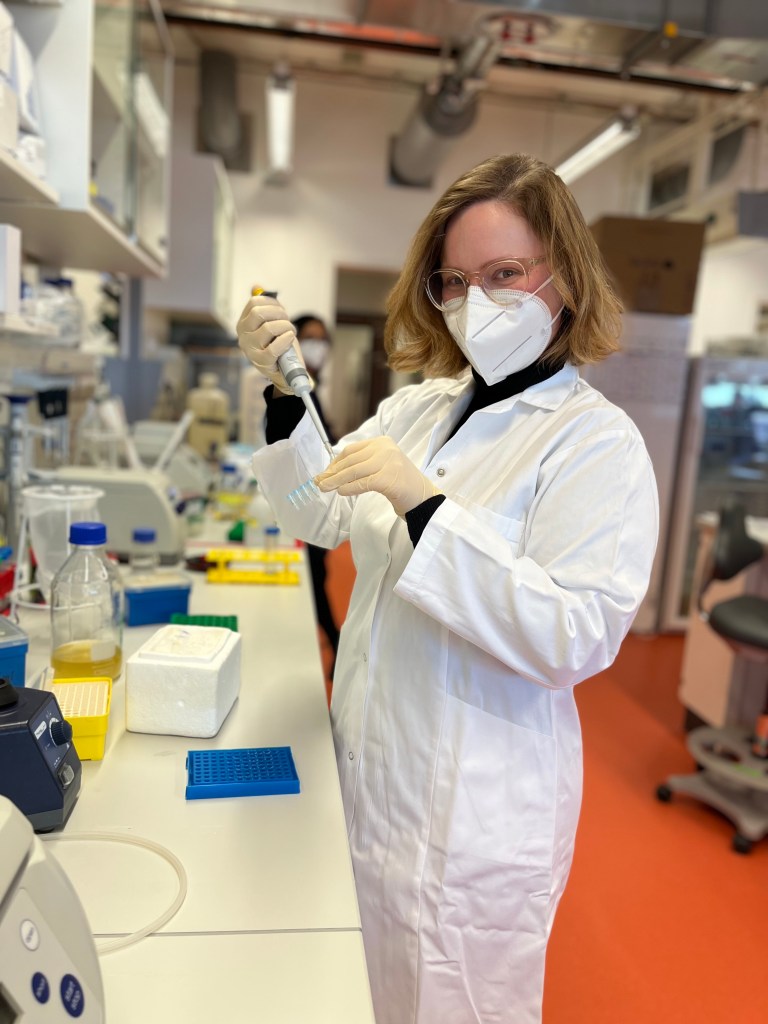
Ludwig-Maximilians-Universität München
Every scientist might have their own five reasons why they love doing science and I would be curious to learn about them as a source of inspiration. Despite the negative aspects raised above, I hope that the positive reasons will motivate young people to work in academia. Maybe, those positive reasons could even become the fuel to slowly improve academic working conditions. And finally, I hope that scientists like me will have time and energy, besides sustaining themselves as scientists, to be good partners, parents, friends and care takers for ageing parents. To live their lives fully and to be an active part of society instead of living a disconnected life in an ivory tower.
You can connect with Vanessa on Twitter.
 Soapbox Science Munich