Why should stories matter for science? by Dr. Anwesha Banerjee

Max Planck Institute of Tax Law and Public Finance
We live in paradoxical times. On the one hand, millions of people have access to science-related information on various forms of social media. On the other hand, there is growing evidence that trust in science is polarized along partisan lines, and appears to be declining, especially for supporters of populist parties (such as the AFD1 in Germany or the Republicans in the United States). This paradox is not without consequence either: widespread protests against mask mandates and other health regulations became a common feature of life during the covid pandemic, and climate change denial continues to be a pressing concern despite the overwhelming scientific consensus on the matter. Misinformation is certainly part of the problem. In a world of post-truth politics, outright lies are rampant – Donald Trump, for instance, has called climate change “mythical”,”nonexistent”, as well as “an expensive hoax” on different occasions.
Though the outright denial of scientific findings dates back to the days when the Church refused to believe that the Earth rotates around the sun, a far more insidious and modern aspect of the problem is that the language of science is often adapted to lies and half-truths. As Yuval Noah Harari put it, “Earlier traditions usually formulated their theories in terms of stories. Modern science uses mathematics.” Modern science developed precise ways of communicating scientific truths. With the increasing use of scientific language in socio-political discourse, it is much easier to share a lie in a convincingly scientific way. And so it hardly comes as a surprise that the groundbreaking documentary on former US vice president Al Gore’s untiring campaign for climate change action, `An Inconvenient Truth’, now has a counterpart in a book called `Inconvenient facts: The science that Al Gore doesn’t want you to know about.’
Such abuses of scientific discourse create conflicting narratives of climate change which often fly in the face of facts. The recent pandemic demonstrated that such distorted information can also emerge regarding vaccinations, especially in uncertain situations where we place trust in scientists to update us with (accurate) information regarding health risks. Conflicting narratives in turn create polarized beliefs amongst members of society, and polarization in beliefs can explain why individuals may withhold from supporting climate change action in the face of overwhelming scientific consensus. This is aptly illustrated in the 2021 Netflix satirical film `Don’t look up‘ (spoilers ahead), a hypothetical story where scientists discover a comet on a trajectory to the earth, large enough to destroy it on impact. They accurately predict the time of impact and try to communicate it to the US government, but they lose control of the narrative to politicians and news agencies that downplay the risks of the event, ultimately leading to the destruction of the earth.
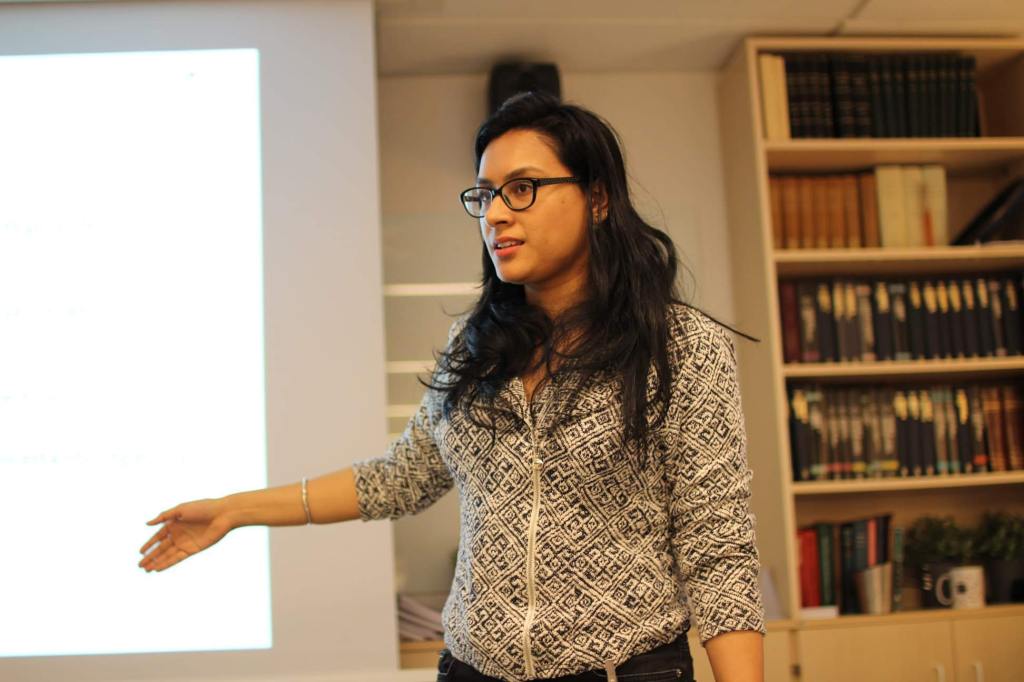
Max Planck Institute of Tax Law and Public Finance
How do we fight misinformation and misinterpretation of scientific evidence? Research indicates that the option to fact-check news may only be of limited help, since people have a tendency not to question news that are aligned with their personal viewpoints. An alternative approach to the problem may lie in narratives, a field that has recently gathered interest in the economics literature. While our understanding of interactions between narratives and information that influence beliefs is limited, recent research suggests that storytelling may play a role in both conveying or combating misinformation. The stories that we share shape our world. In the future, as in the past, the impact of groundbreaking scientific work may well depend on the minimizing of conflicting social narratives that arise from this research.
1 Alternative for Germany (German: Alternative für Deutschland)
You can connect with Anwesha on Twitter, LinkedIn, or her Website.
 Soapbox Science Munich