Interview with Avani Koparkar

University of Tuebingen
Soapbox: During your journey as a scientist, what challenges have you encountered along the way? And if you had the power to alter one (or more) aspect(s) of the scientific culture, what would you change and why?
Avani Koparkar: I started my scientific journey in India. One of the main problems I faced, not being part of the western academia, was lack of opportunities. When you must ask for funding each time you write to a lab you’re interested in, and then apply and wait for a visa when you finally get the internship, it really holds you back. Even today, whenever there is a major conference held in Canada, or the UK, I have to go through a tedious bureaucratic process to get there. One thing I would like to change about scientific culture is its inapproachability. It would be great if there were summer schools, or conferences there were held in more visa-friendly countries in the east. This would probably solve the problem of the sky-high conference and summer school fees as well. Wake up, people! Science is supposed to be global.
Soapbox: What attracted you to Soapbox Science in the first place? Sum up your expectation of the Soapbox Event in three words.
AK: I always wanted to be a part of a science communication event. Unfortunately, the language barrier ruled out a lot of options for me. I really like that Soapbox science is a more inclusive platform, not only in terms of speaker diversity, but also in terms of language of communication. My expectation of Soapbox Event? Inclusive. Fun. Informative!
Soapbox: What role do you believe science communication plays in bridging the gap between researchers and the general public?
AK: Our research is funded by taxpayer money. The onus is now on us to explain to the general public the purpose for which their money is being used. For example, think of the misinformation that was circulating during the COVID-19 pandemic about the nature of the mRNA vaccines. With large-scale, effective science communication, especially at the level of universities, we could have managed to quell a lot of the panic.
I think science communication is extremely crucial today, where scientific advancements are made at a breakneck speed. It is our job as scientists to make sure we take the general public with us in understanding these advances.
Soapbox: How do you think diversity and inclusion in the scientific community contribute to innovation and progress?
AK: Science is all about creativity. Building a diverse and inclusive scientific community can fuel discussions and kick start the creative process.
Moreover, science is single faceted without inclusivity. For decades, medical techniques and the science of mental health has been benchmarked against a population of western individuals, particularly males. It is important to have scientists of different backgrounds to include these underrepresented perspectives and make science accessible to everyone.
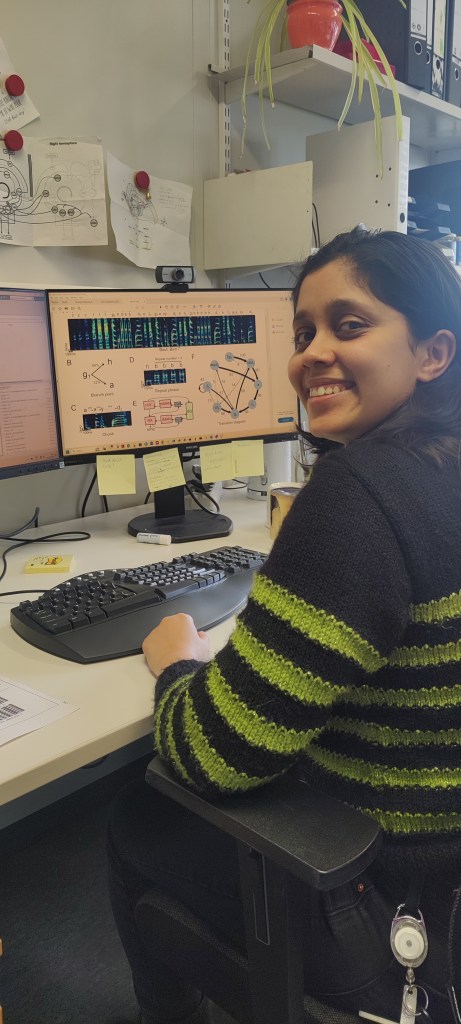
University of Tuebingen
Soapbox: What is your day-to-day scientific-superpower and how does it help you with your work?
AK: My day-to-day superpower is resilience. Scientific research is not very rewarding on a day-to-day basis. Your experiments fail suddenly, your setup breaks down, your code just doesn’t work and sometimes, you don’t get the results you wanted so badly. I have learned to shake off the failures and not to let the failures of yesterday affect my work today. I have come to accept that science cannot provide you with instant gratification, and that you have to simply work through your disappointment to get to the results.
You can connect with Avani on X.
 Soapbox Science Munich