Artificial muscles for lifelike robots by Ellen Rumley
When you think of the future, what technologies do you envision existing? Flying cars? Humanoid assistants? How about artificial muscles?

Max Planck Institute for Intelligent Systems
The latter is at the center of my doctoral work. Artificial muscles have the potential to function as alternatives to traditional motors for making life-like robots and wearable devices. Although traditional motors are impressive machines that are useful for their high speeds, strengths, and controllability, soft muscle-like alternatives could be useful for making machines that can move through the world as elegantly as our own biological bodies.
The particular artificial muscle technology I am developing was first invented by my research group in 2018, and since then we have steadily improved their design. Called HASEL (short for “Hydraulically-Amplified, Self-Healing, Electrostatic”) artificial muscles, they are capable of contracting faster than biological muscle, have higher energy efficiency compared to traditional motors, can be entirely biodegradable, and be versatile enough to control a range of devices from grippers to swimming jellyfish robots.
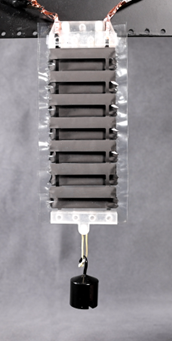
In principle, the general mechanism of HASEL artificial muscles is fairly simple. Oil-filled plastic bags are partially covered by a layer of flexible and electrically conductive material (conductor). Applying a high voltage across the conductors generates a force that pushes oil out of the way and deforms the bag, much like a bicep contraction. And just as our human muscles are used to move and lift weights, the deformation of HASELs can be used to generate motions and forces.
In reality, however, HASEL artificial muscles are not so trivial. My research department keeps busy investigating just how these artficial muscles really work, and how we can unlock their full technological potential. For example, under the influence of high voltage, they begin to show interesting, complex behaviors that bear resemblance to phenomena present in high-voltage transmission lines, opening up interesting fundamental physics questions. Another area for research exploration is presented by the high customizability of HASEL artificial muscles; they can be made into a wide variety of shapes and sizes, which consequently changes how they move in response to high voltage, giving researchers the flexibility to design geometries catered for a desired application.
With the sheer number of research opportunities and challenges that remain to be tackled around our technology, it can sometimes feel daunting to envision a finishing line, some form of a final product. As scientists, we have a tendency to dive deep into solving specific challenges, and can lose sight of the bigger picture in the process, such as: Where will our artificial muscles be best utilized in the future? Where can we realistically take this technology in ten years?
Max Planck Institute for Intelligent Systems
I often find inspiration to answer these kinds of questions not in the laboratory, but while interacting with the people outside my research world, during dinner conversations or chats with a neighboring plane passenger. When asked about the potential impacts of our technology, the answers I would receive from research peers that work on HASELs on the daily could differ quite drastically from the answers I would receive from those outside of my academic bubble. As I explain the functionality of our artificial muscles to someone for the first time, I see their eyes light up, and from their unguarded, curious stance, they rattle out the possible applications of my work. “Could your oil bags help me walk without joint pain?” “Those sound promising for powering prosthetic arms!” “Can you make my husband a robotic seeing dog?” The enthusiasm and curiosity with which our technology is met helps kindle my own curiosity in my work, and helps to encourage me to see its potential and re-ask myself the what-ifs. What if in 10 years we can develop exoskeletons for assisting human mobility in older age? What if robotic seeing dogs and humanoid assistants are not so far into the distant future?
While it is difficult to predict how the application and design trajectory of HASEL artificial muscles will evolve in the future, I find comfort in knowing that my small contribution to this field can serve as one of many stepping stones that future scientists can use to deliver the stuff of science fiction into reality.
 Soapbox Science Munich