FUEL your imagination – tiny activator bricks, big impact
– Interview with Simone Poprawa

TUM, School of Natural Sciences, Faculty of Chemistry
Soapbox: During your journey as a scientist, what challenges have you encountered along the way? And if you had the power to alter one (or more) aspect(s) of the scientific culture, what would you change and why?
Simone Poprawa: One of my biggest challenges is the emotional rollercoaster that comes with experiments not working. You’ve spent so much time planning, preparing, and analyzing to see – nothing? An unexpected bad result? That’s tough and can make you struggle with your confidence, even question your scientific reliability in particular and your choice of doing a PhD in general.
But negative results are important, they teach us something and may guide us in new directions. Yet, our current scientific culture tends to sweep them under the rug – to only highlight the “shiny, fantastic, smoothly running” successes in presentations and publications.
If I had the power to change one thing, it would be this: I’d build a culture that values transparency, where we’re encouraged to share not only what worked but also what didn’t. Imagine how much faster science and innovation could progress if we all learned from each other’s negative results and failed experiments instead of repeating them.
It’s easy to feel like failure is unique to you, but guess what? It happens to all of us!
Soapbox: What attracted you to Soapbox Science in the first place? Sum up your expectation of the Soapbox Event in three words.
Simone: My three words to sum up my expectations are: Excite, Inspire and Grow.
Excite – I want people to get excited about fundamental research and show how fascinating science can be, even to those who don’t work in this field. I’d love to learn how to communicate my research in a simple and engaging way — something I’ve always wanted to do better, particularly when talking to friends and family.
Inspire – By sharing my enthusiasm and putting myself out there, I hope to inspire others, especially young women, to consider STEM fields. If I can spark curiosity or confidence in just one person, it would be a success.
Grow – I’m someone who usually avoids being the center of attention, so this is a personal challenge. I see this as a unique opportunity to step outside my comfort zone. The supportive Soapbox Science environment, along with the workshop and community, feels like the perfect setting to learn, build confidence, and connect with others.
Soapbox: How do you think diversity and inclusion in the scientific community contribute to innovation and progress?
Simone: Innovation and progress are just the natural results of diversity and inclusion. In chemistry, a universal chemical language connects all of us despite the many different spoken languages. Even though we start with the same base, our knowledge, or better focus of knowledge, is different depending on our background and cultures. Working together, we complement each other automatically. This leads to new ideas and various problem-solving skills and strategies, which drive innovation. On a social level, we get to know different people and appreciate our differences as well as our similarities. A diverse and inclusive community should be just normal.
I’m so happy to be in a supportive and empowering group surrounded by great people.
Soapbox: What advice would you give to someone interested in pursuing a career in science, particularly young women who may be hesitant to enter the field?
Simone: What’s hindering you from going for it?
Yes, it can be challenging from time to time, you have to push through, but those moments help you become stronger and more confident.
If you don’t know what kind of STEM studies you want to start, many universities offer orientation semesters or programs that let you explore different fields (https://www.ed.tum.de/en/ed/studies/degree-programs/mint-orientation-certificate/, https://www.komm-mach-mint.de). They are great ways to get to know what interests or suits you.
And remember, it’s okay to change your mind. If you realize a particular path isn’t right for you, that’s fine. What matters is that you gave it a try. Regret often comes from not trying at all, not from changing direction.
Soapbox: What is your day-to-day scientific-superpower and how does it help you with your work?
Simone: My day-to-day scientific-superpowers are kindness and resilience. Being kind to others lifts the group spirit and makes the people in the group work better together. It may also help others to be more resilient and cope better with tough and stressful situations. Additionally, to me, others’ successes feel as great as my own. Resilience, on the other hand, is, in my opinion, one of the most important but also hardest superpowers to unleash. But it helps so much if you can recover (more or less) quickly from unexpected drawbacks.
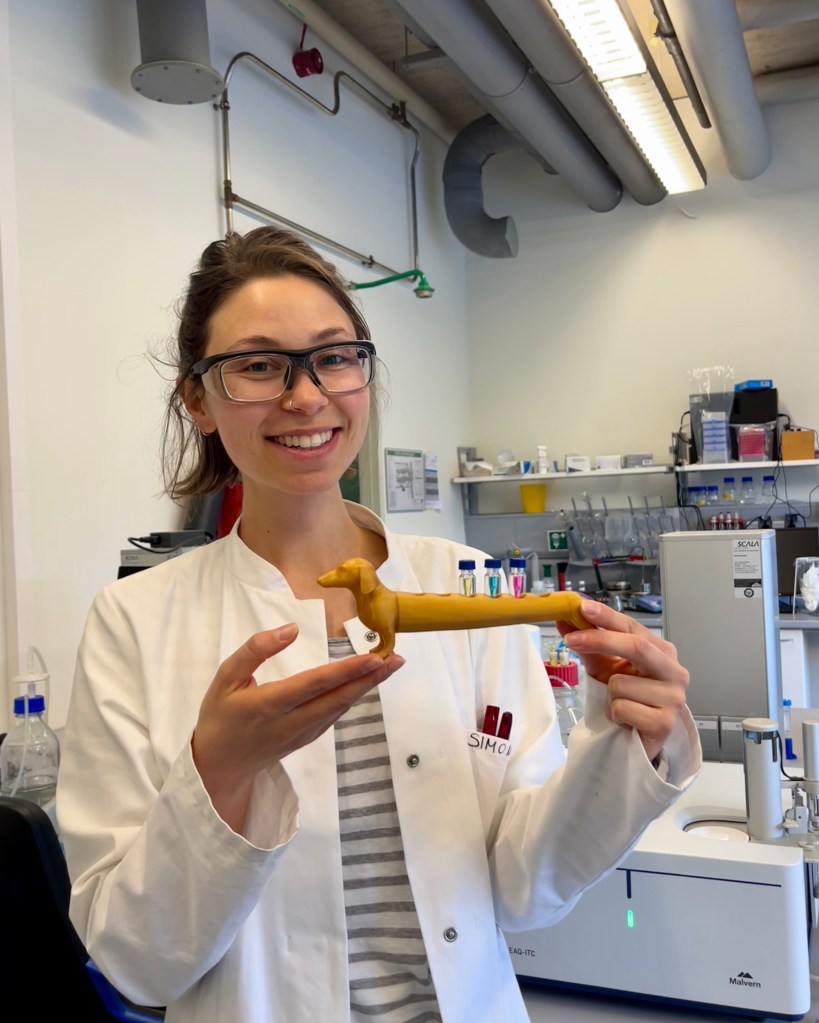
TUM, School of Natural Sciences, Faculty of Chemistry
Soapbox: Do you have any fascinating do-it-at-home experiments, books, podcasts, or talks that you’d suggest for a good laugh or some interesting insights?
Simone: I think the most fascinating do-it-at-home experiments are cooking dishes you haven’t tried before. Unlike in the lab, you can lick the spoon, that’s the best part! 😉
And a book always on my nightstand is “Wahre Rebellinnen – 100 Frauen, die die Welt auf den Kopf stellten“ by Carina Heer. It’s a beautiful book about totally different women being rebellious in their own way.
 Soapbox Science Munich