Underwater Architects: A Cichlid’s Guide to Building the Perfect Home
– Interview with Swantje Grätsch

Max Planck Institute for Biological Intelligence
Soapbox: Did you choose a scientific career or did the scientific career choose you? Can you tell us about your journey into the world of science and what inspired you to pursue your particular field?
Swantje Grätsch: So far, I’ve had the privilege to follow my heart and pursue the topics that fascinated me most. As I navigated from basic biology (Bachelor’s) to neuroscience (Master’s and PhD), and now to neuroethology during my Postdoc, I’ve received incredible support and opportunities to see new places, meet fantastic people, and, most importantly, work on fascinating questions. I love the supportive and collaborative atmosphere in my current field, where people get super excited about the funky behaviors of weird critters (the weirder, the better!). So, I get really fascinated by the diverse behaviors animals show and draw a lot of inspiration from the people who study them.
Soapbox: During your journey as a scientist, what challenges have you encountered along the way? And if you had the power to alter one (or more) aspect(s) of the scientific culture, what would you change and why?
Swantje: Research is a highly competitive field, and I think that the system often pushes people to specialize early and stay in this one lane. This can make it quite tough to explore other fields or even take a break—for example, to start a family—without feeling like you’re falling behind. I’ve done both: I switched fields and took a baby break, and I wish these things were less of a challenge for future scientists. In my opinion, we lose too many brilliant minds because the future prospects in this race-to-the-top culture can feel pretty discouraging.
Soapbox: What role do you believe science communication plays in bridging the gap between researchers and the general public?
Swantje: Making science accessible and understandable for everyone is extremely important! As researchers, we often live in a bit of a bubble (labs, conferences, lectures), and only after years of work do we publish our findings. Sharing those insights with other scientists is great, but it’s also so much fun to excite people who don’t usually deal with science or research. Plus, especially nowadays, with misinformation spreading around fundamental scientific concepts, it’s crucial that science stays visible and approachable. In my experience, when complex topics are presented in a digestible way, people do get curious and start to wonder. And honestly, every ‘naïve’ question has the potential to become a cool experiment 🙂
Soapbox: What is your day-to-day scientific-superpower and how does it help you with your work?
Swantje: I would say that finding creative solutions, or being creative in general, has always been very beneficial for my scientific work. I use this ability, for example, when building a new setup or designing new experiments, but it also helps when I present my work; I love turning my work and findings into little cartoons, for instance.
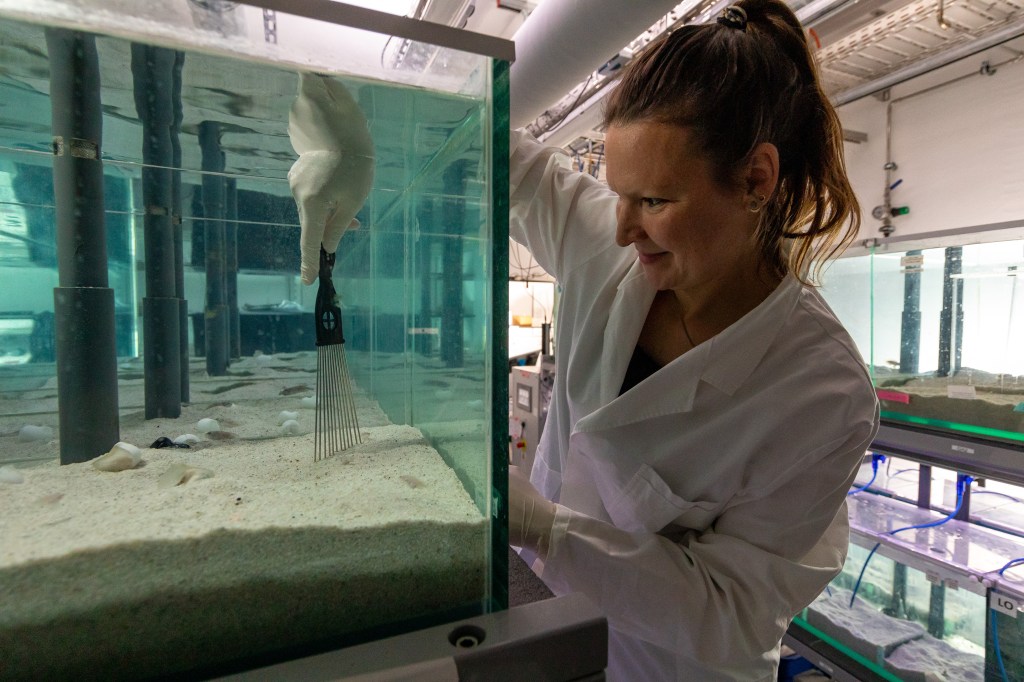
Max Planck Institute for Biological Intelligence
Soapbox: If you were to embark on a Robinson Crusoe-style adventure and ended up on a deserted island, which scientific gadgets or gizmos would turn your survival into a scientific escapade?
Swantje: Me working on a deserted island? JACKPOT!! I’d definitely bring some filming gear like high-speed, night vision, underwater, and aerial cameras. Maybe a mobile arena to study animal behavior in controlled conditions as well, and of course my drawing materials. And then you can literally just leave me there and I’ll happily spend my days studying every creature I can find!
You can connect with Swantje on Instagram or via https://www.bi.mpg.de/baier/cichlids .
 Soapbox Science Munich