If Ocean animals could speak
– Interview with Cindy Saru Chorongo
Technical University of Munich
Soapbox: Did you choose a scientific career or did the scientific career choose you?
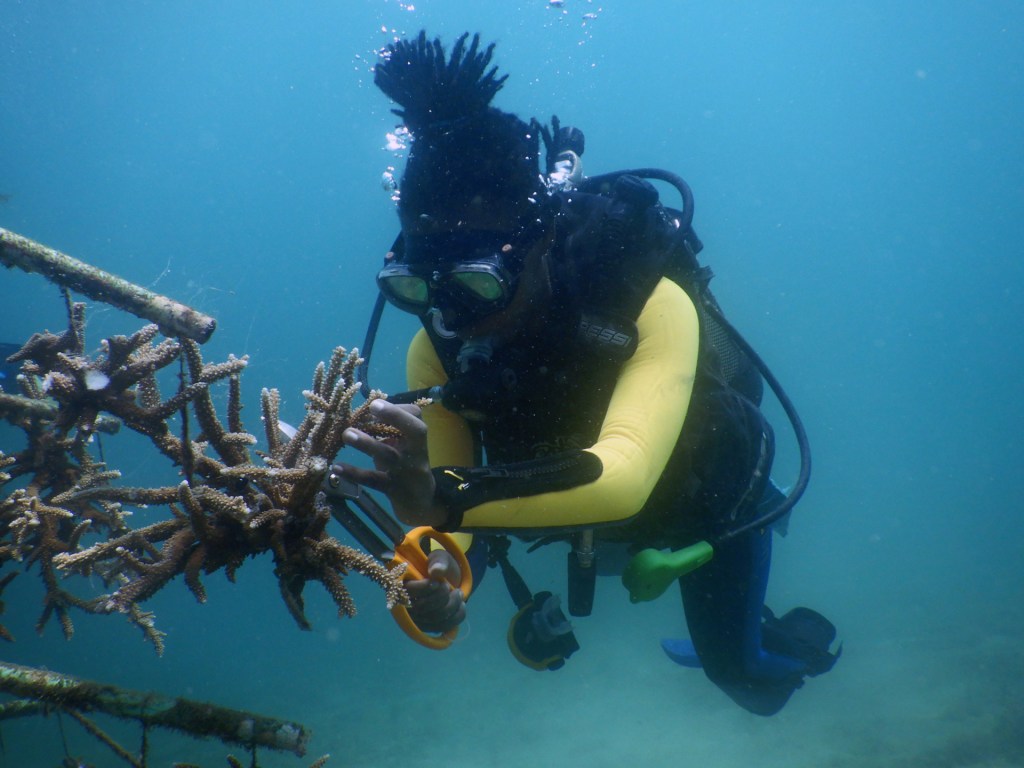
Cindy Saru Chorongo: The scientific career chose me. Growing up in a coastal city, I was endlessly fascinated by the ocean — I wanted to know what lay below and beyond, and just how far it extended. It felt natural to pursue a path that combined curiosity, action, and stewardship. For my Bachelor’s, I initially chose to study Marine Engineering, believing that working on boats would be my gateway to the ocean. At the time, there weren’t many visible role models in marine science, so engineering felt like the closest path. However, the course was never launched due to a low number of applicants, and I was heartbroken. Luckily, my university proposed a Bachelor of Science in Marine Resource Management instead, which turned out to be exactly what I had been looking for — giving me the academic tools and knowledge to explore my true curiosity. Working hands-on in coral restoration with REEFolution Kenya through SCUBA diving showed me firsthand how science can actively heal ecosystems. From there, everything flowed organically—from founding a turtle conservation NGO to communicating marine science through public education initiatives.
Soapbox: What challenges have you encountered along the way?
Cindy: A major challenge has been navigating the gap between scientific knowledge and public understanding. Often, vital information remains locked behind academic walls. If I could change one thing about scientific culture, it would be to elevate communication and community engagement to the same status as research outputs. Science shouldn’t exist in isolation—it should inspire action!
Soapbox: What is the most fascinating aspect of your work?
Cindy: One of the most profound moments was during a coral restoration project: just a day after we restored an area underwater, we found a fish already living in the newly placed coral structures, fiercely defending its new home. It even tried to chase us away! That tiny act of territorial protection felt like a huge validation — a reminder that when science meets passion and action, real and immediate transformation can happen.
Soapbox: What attracted you to Soapbox Science?
Cindy: I love making science accessible and alive for everyone—not just for specialists. Soapbox Science embodies exactly what I believe in: breaking down barriers between science and society.
Soapbox: What role does science communication play?
Cindy: Science communication transforms research into understanding. It empowers people to make informed choices and builds trust in knowledge. In a world facing complex crises, connecting science with everyday lives has never been more important.
Soapbox: What misconceptions exist about scientists?
Cindy: People often imagine scientists as distant or unapproachable. I want to change that by showing the heart, passion, and creativity that drive our work. Scientists are not removed from society—we’re deeply part of it, working to protect what we all care about.
Soapbox: How do diversity and inclusion contribute to science?
Cindy: Diverse teams bring different perspectives, leading to richer ideas, more creative solutions, and better science. When different voices are heard, innovation flourishes. Marine conservation, for example, is stronger when it integrates indigenous knowledge, community voices, and global science.
Soapbox: Advice for young women in science?
Cindy: Trust that your perspective is valuable. You belong in every room you walk into. Science needs your curiosity, your resilience, and your unique voice. Build your own table if you don’t find one that welcomes you—and invite others to join.
Soapbox: Your day-to-day scientific superpower?
Cindy: Translating complexity into clarity! Whether it’s turning research into a short educational video or designing engaging event materials, my strength is making science accessible and relatable without losing its depth.
Soapbox: Your survival gadgets on a deserted island?
Cindy: A water testing kit (to ensure safe hydration), a GPS beacon (because fieldwork taught me to never underestimate navigation), and a GoPro (because every adventure deserves documentation—and maybe to send a distress signal through epic underwater footage!).
Technical University of Munich
Soapbox: At-home experiments/books/podcasts/talks you recommend?
Cindy: Try growing your own coral at home—okay, not quite! But I recommend reading “The Soul of an Octopus” by Sy Montgomery, it explores the emotional and physical world of the octopus, and a humbling experience into ocean life. For podcasts, “How to Save a Planet” is brilliant for eco-hope and laughs. And for a feel-good science moment, check out my documentary by Voice of America where among three I am featured as an Eco-warrior of Africa: https://youtu.be/iKP4C7Vi8DY?si=o2QuCJ5bnPPDQKKZ
 Soapbox Science Munich