To see or not to see!
– Interview with Huma Khatoon

Helmholtz Zentrum München, Institute for Biological and Medical Imaging (IBMI)
Soapbox: Did you choose a scientific career or did the scientific career choose you? Can you tell us about your journey into the world of science and what inspired you to pursue your particular field?
Huma Khatoon: I would like to believe that the scientific career chose me. Growing up, I was surrounded by a family of businessmen- quite different from anything that could leave an impression on me as child for a career in science. The world of basic sciences has always intrigued me- the idea of breaking down the complex questions of life to atoms and molecules. To understand life on a molecular level, I started with a major in Chemistry. Afterwards, I shifted to a PhD in Structural Biology and Biomedical Imaging, owing to the impact that I wanted my science to leave as a researcher and I am glad there has been no looking back from there!
Soapbox: What attracted you to Soapbox Science in the first place? Sum up your expectation of the Soapbox Event in three words
Huma: I have always believed that people are interested in science, we just need to hold the door open! Soapbox Science, as a platform to make complex scientific research accessible and engaging for the general public came as that door-opening opportunity for me. To be able to tell them that there are no inherently wrong questions in science! To be able to tell them that there are no boundaries whatsoever in science! To be able to explain to them what we do and why we do it so passionately! I am sure the event will be fun, engaging and impactful!
Soapbox: What role do you believe science communication plays in bridging the gap between researchers and the general public?
Huma: There is a famous saying- knowledge increases upon sharing. Science communication expands the total pool of knowledge, validates and strengthens existing knowledge, and encourages further learning and development. It allows the public to have an opinion of their own on scientific matters, fostering trust in science and helps them to take informed decisions. It is also important for the public, especially young people, not to be scared by how science can be perceived as not everyone’s cup of tea but to be able to see themselves as scientists one day!
Soapbox: What misconceptions do you think people often have about scientists, and how do you aim to change those perceptions?
Huma: I feel the misconceptions that people mostly have about scientists are that we are nerds or geniuses. The truth being that scientists strive more for brilliance than intelligence! We have our own interests in art, culture, travel and sports. There is another misconception that we work in isolation with scientific ideas which are mostly absolute and unchanging. On the other hand, the reality being that the science community prospers through its collaborative mindset and is constantly evolving as new ideas emerge.
Soapbox: What advice would you give to someone interested in pursuing a career in science, particularly young women who may be hesitant to enter the field?
Huma: My advice to someone interested in pursuing a career in science would be to take that risk. Choosing a career in academia may not always be rewarding but it all comes together in the end, giving you a sense of fulfillment for the choices you made. The high school me would never imagine being a scientist and loving what I do! All that matters is taking that step forward and making your own decisions and being responsible for the consequences that may come by! The world is evolving into a space where women are excelling everywhere- why leave out the field of science?
Soapbox: What is your day-to-day scientific superpower and how does it help you with your work?
Huma: My day-to-day scientific superpower would be consistency and resilience. If I am having a good day, you will find me in the lab. If I am having a bad day, you will still find me in the lab! I have learnt through the years that a scientific career is more of a journey than a destination- you can shape your own curve in terms of growth, learning and goals. On days my experiments do not go as expected, I get even more excited or curious to troubleshoot or know why? Because even failed results are answers to the questions that did not exist in our minds! In the long run, this has helped me quite a lot.
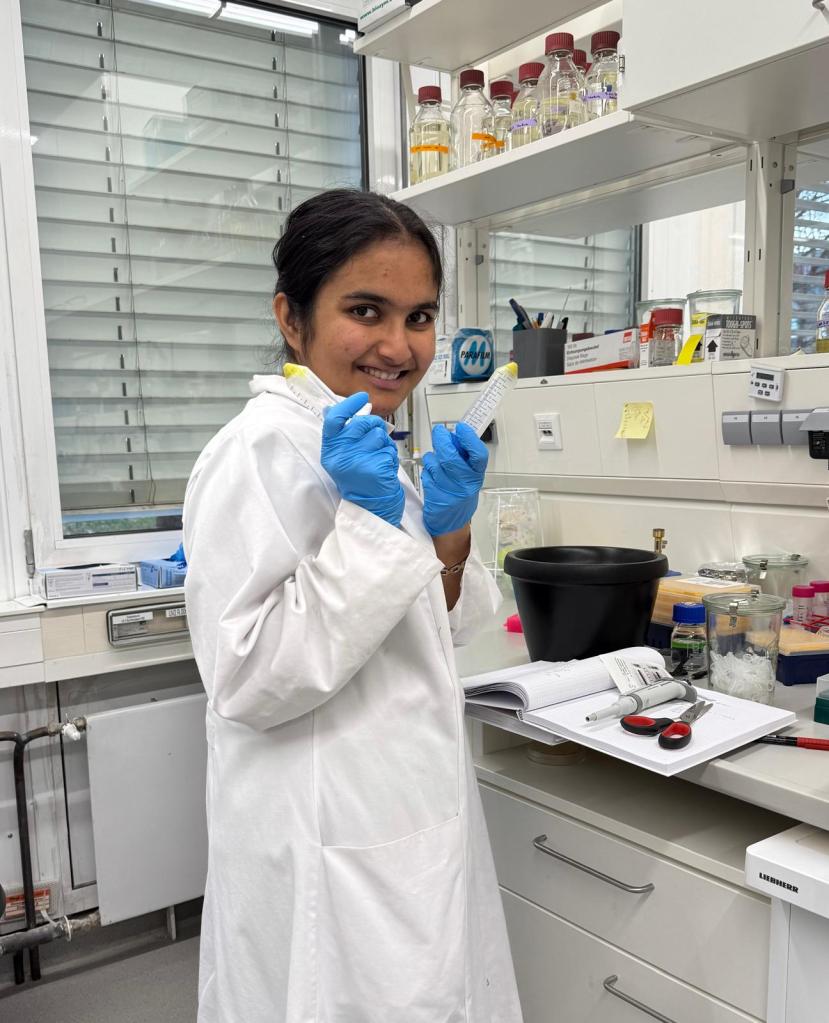
Helmholtz Zentrum München, Institute for Biological and Medical Imaging (IBMI)
Soapbox: Do you have any fascinating do-it-at-home experiments, books, podcasts, or talks that you’d suggest for a good laugh or some interesting insights?
Huma: Books like “A Short History of Nearly Everything” by Bill Bryson, “Surely You’re Joking Mr. Feynman!” by Richard P. Feynman and “The Breakthrough” by Charles Graeber are always fascinating to read. Quite recently, I came across these series of “Books for Babies” by Chris Ferrie on topics like “Quantum Physics for Babies”, “Calculus for Babies” or “Rocket Science for Babies”- quite cool as a concept to explain complicated topics to beginners and have some amazing initial ideas on it!
You can connect with Huma on Instagram.
 Soapbox Science Munich