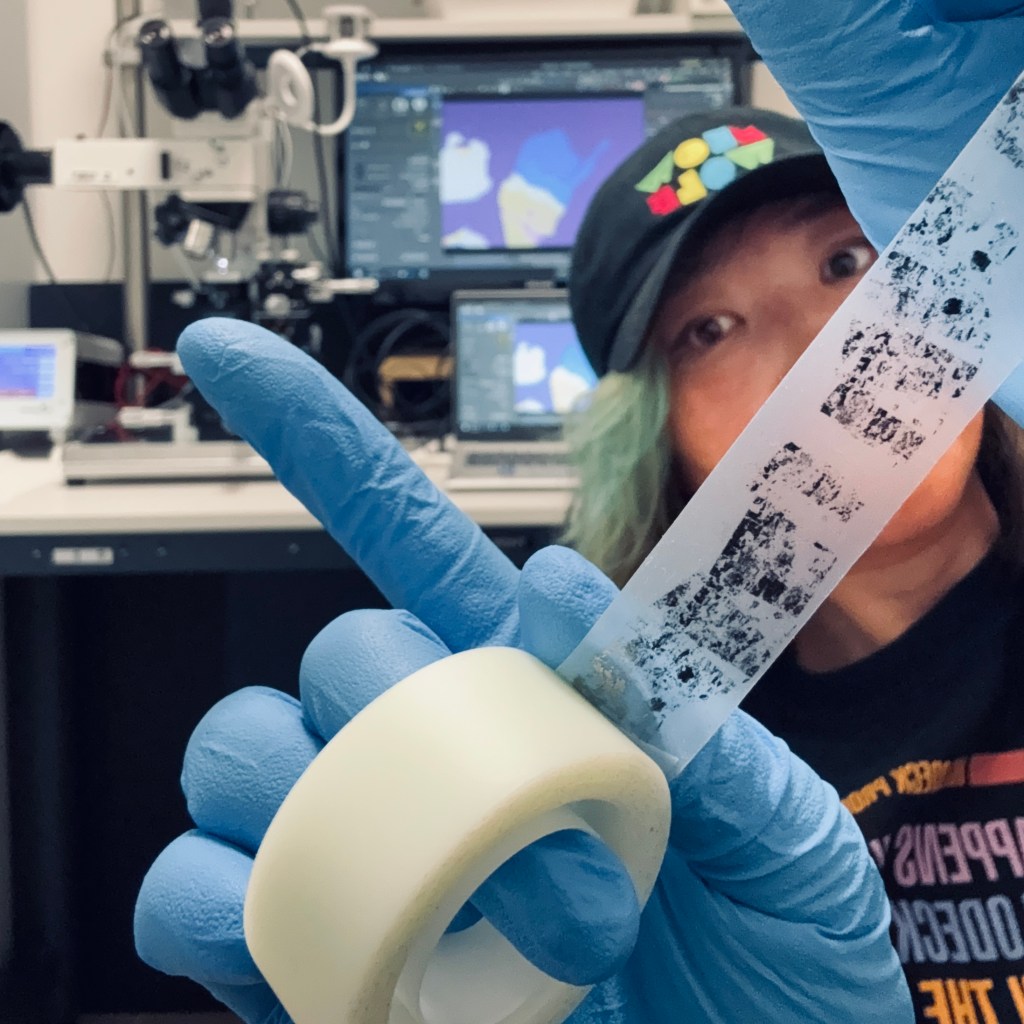
Scotch tape magic – 2D device fabrication
– Interview with Lin Nan

Ludwig-Maximilian University of Munich
Soapbox: Did you choose a scientific career or did the scientific career choose you? Can you tell us about your journey into the world of science and what inspired you to pursue your particular field?
Lin Nan: I’d say I chose science—but with a gentle nudge from my grandpa. I have a clear memory of him, a retired microbiologist, building a little DIY “lab” in his garage where he ran home experiments just for fun. I was under 10, and he’d let me tag along to help with his “experiments,” which mostly involved strange smells, bubbling liquids, and me trying not to break anything. He absolutely loved it, and I remember thinking, I want to grow old just like him.
That stuck with me. I didn’t immediately know what field I wanted to pursue, so I wandered a bit—dabbling in mechanics, detouring through materials science—until I eventually stumbled into nanoscience, where I found my true passion. Somewhere along the way, I realized: this is my thing. It felt right—like I’d found a field I could enjoy just as much as my grandpa had loved his.
Soapbox: What do you think is the most fascinating aspect of your research/work? Can you share a memorable or rewarding moment from your career that illustrates the impact of scientific research on society?
Lin: I find learning and developing new techniques and processes in research incredibly rewarding—it gives me a real sense of fulfillment in my day-to-day work. However, to my surprise, the most meaningful moment so far wasn’t in the lab; it happened when I gave a talk at an interdisciplinary workshop. One of the listeners was a 12-year-old girl, the daughter of one of the PIs. After my presentation, she came up to me and told me that my talk was the easiest for her to follow and that she really enjoyed it. That simple moment—connecting with someone so young and curious—stayed with me. It even inspired me to apply for the Soapbox event, because I realized how powerful and important science communication can be.
Soapbox: What attracted you to Soapbox Science in the first place? Sum up your expectation of the Soapbox Event in three words
Lin: Continuing from the previous answer, I think it is truly rewarding to inspire a curious young mind. I believe the Soapbox Science event can be a great starting point for me to do just that. To sum up, I hope the Soapbox event will be fun, captivating, and inspiring
Soapbox: What advice would you give to someone interested in pursuing a career in science, particularly young women who may be hesitant to enter the field?
Lin: Don’t be afraid. From my experience, you truly start to understand whether a field is right for you only after you get involved in it. It’s okay if your first choice isn’t the perfect fit—what matters is taking that first step. Science is a broad and flexible world, and there’s always room to explore, shift directions, and eventually find what really excites you. Don’t be discouraged by uncertainty; use it as a space to grow.
Ludwig-Maximilian University of Munich
Soapbox: What is your day-to-day scientific-superpower and how does it help you with your work?
Lin: Gambiarra, this is a term in Brazilian Portuguese that refers to a form of creative problem-solving, often characterized by resourcefulness and adaptability. This ingenuity is especially valuable in experimental research, particularly in nanophotonics, where fabrication and measurement tools can be costly and time-consuming to acquire. When working with complex setups, unconventional materials, and tight deadlines, the ability to improvise and devise unconventional solutions can be a game-changer.
You can connect with Lin on LinkedIn.
 Soapbox Science Munich