Partner in Care: Human Skill meets Robotic Support
– Interview with Nina Müller
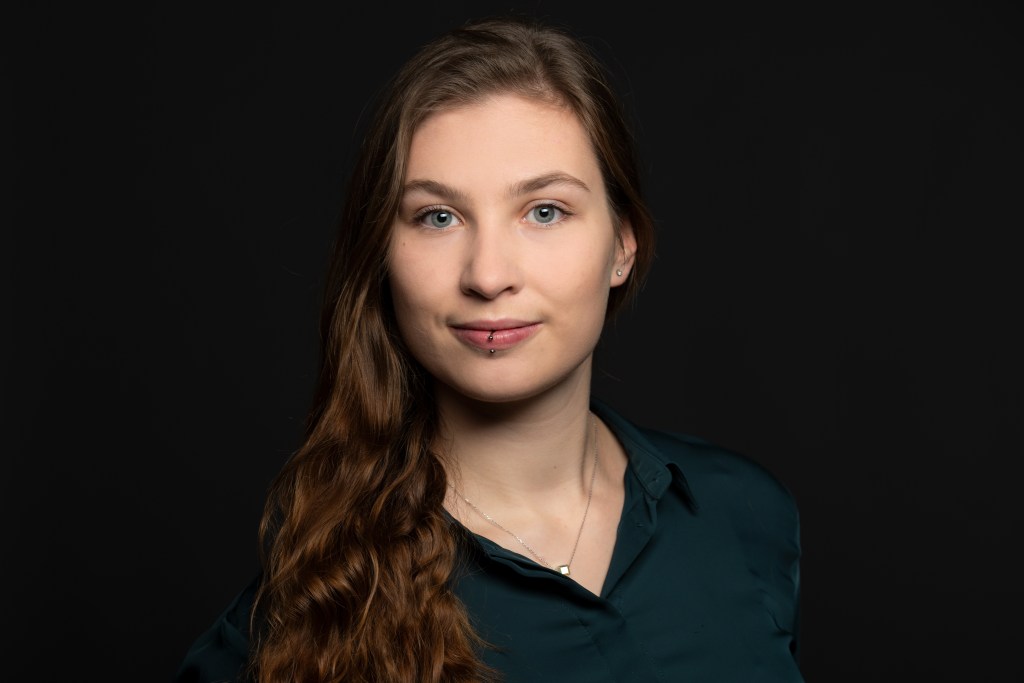
Research Group MITI, TUM University Hospital
Soapbox: Did you choose a scientific career or did the scientific career choose you? Can you tell us about your journey into the world of science and what inspired you to pursue your particular field?
Nina: When I reflect on it more closely, I realize that both perspectives apply to me. Already in elementary school, I was convinced that I wanted to become a professor one day, ideally in the field of medicine. For various reasons, that specific path did not work out. However, I had always been deeply interested in science and technology, and through my father’s job I developed a strong fascination for robotics. After graduating from high school, I therefore decided to pursue a dual degree in mechanical engineering. I later completed a master’s degree, during which I joined my current research group as a student research assistant. The projects and tasks immediately captured my interest, and working on robotic systems in a clinical setting allowed me to combine my passion for engineering with my original interest in medicine. To further deepen this connection, I spent a semester abroad in Japan, where I wrote my master’s thesis in a laboratory focused on computer-based biomedicine. Following this experience, I applied to the PhD program I am currently enrolled in. Looking back, I do not regret any of the decisions that led me here. On the contrary, I would choose the same path again without hesitation.
Soapbox: During your journey as a scientist, what challenges have you encountered along the way? And if you had the power to alter one (or more) aspect(s) of the scientific culture, what would you change and why?
Nina: One of the biggest challenges I have faced is dealing with self-doubt while simultaneously trying to solve every problem perfectly – two tendencies that often stand in direct opposition to each other. Working in science means constantly being surrounded by exceptionally smart colleagues, and at times I feel like the smallest candle on the cake, questioning whether I truly deserve to pursue a PhD or whether I am “smart enough.” While much of this comes from within, I know that many people in academia experience similar feelings. Another challenge is maintaining a healthy work–life balance – or in my case, rather a work–work balance. I genuinely enjoy working, and during a PhD it can sometimes feel as if being a scientist is my job while doing a doctorate is my hobby. If I could change anything about scientific culture, it would be the widespread use of short-term contracts and the resulting insecurity, as well as the often frustrating and opaque peer-review process for journals and conferences.
Soapbox: What do you think is the most fascinating aspect of your research/work? Can you share a memorable or rewarding moment from your career that illustrates the impact of scientific research on society?
Nina: The most fascinating aspect of my work is that it brings together two fields I deeply care about: medicine and robotics. I truly feel that I get the best of both worlds – along with relatively structured working hours, which is a nice bonus. Because we work directly within the clinical environment, we collaborate closely with medical staff and, in some cases, with patients. This proximity allows us to identify real challenges in everyday clinical practice and then develop technical solutions that directly address them. A particularly rewarding part of my work is conducting studies in the area of human–robot interaction. In these settings, I can see firsthand how our robotic systems support clinical staff and how open and curious they are to try them out. I am very grateful to our medical colleagues for their openness and collaboration, and every piece of feedback we receive.
Soapbox: What attracted you to Soapbox Science in the first place? Sum up your expectation of the Soapbox Event in three words.
Nina: I had been wanting to take part in a science slam or a similar format for quite some time. When the Graduate School shared Soapbox Science, I checked out the website – and was immediately hooked. I applied right away.
My expectations in three words: inspiring, pushing-me-out-of-my-comfort-zone, and motivating.
Soapbox: What role do you believe science communication plays in bridging the gap between researchers and the general public?
Nina: I believe science communication is extremely important in order to clearly explain the current state of research – what is being studied, why it matters, how it is investigated, and, most importantly, what its implications are. It can also be very inspiring to receive feedback from people outside one’s own research bubble, as it often brings in new perspectives and questions. In my particular field, research outcomes may ultimately affect a broad cross-section of society. For this reason, I think it is essential to communicate openly about our work – not only to inform, but also to address uncertainties and reduce potential fears by making the technology more understandable and approachable.
Soapbox: What misconceptions do you think people often have about scientists, and how do you aim to change those perceptions?
Nina: One common stereotype is that scientists are arrogant or somewhat detached – spending their days isolated in laboratories, working on abstract problems that we have largely invented ourselves. To a certain extent, I can understand where this perception comes from. However, it overlooks the human side of science. I believe events like Soapbox Science play an important role in breaking down these stereotypes. They make scientists visible and approachable in an authentic way, showing that we are simply humans who are curious and passionate about certain questions and choose to pursue them professionally.
Soapbox: How do you think diversity and inclusion in the scientific community contribute to innovation and progress?
Nina: I believe diversity and inclusion are essential drivers of innovation and scientific progress because they bring together a wide range of perspectives, experiences, and ideas. When people with different backgrounds approach the same problem, they often see possibilities that others might overlook. This diversity of thought allows the scientific community to be more creative, adaptive, and ultimately more impactful.
My supervisor often illustrates this with a simple metaphor: he holds up a paperclip and explains that, in theory, you could use it to get to the moon. The key message is that we should not let “growing up” or becoming established in our careers limit our creativity. A child would come up with countless imaginative ways to use a paperclip to reach the moon, simply because they are not constrained by conventions or assumptions. In the same way, diversity and inclusion help preserve this openness in science in my opinion.
Soapbox: What advice would you give to someone interested in pursuing a career in science, particularly young women who may be hesitant to enter the field?
Nina: Do it. Don’t let others intimidate you, and don’t let your own thoughts limit you. If you are interested in science and bring the motivation to learn, you can achieve far more than you might initially believe. My advice is to stay curious and proactive during your studies. Try to connect with people and don’t be afraid to ask questions. Take on student or research assistant positions in different research groups to gain insight into what scientific work actually looks like and to find out whether it suits you. And most importantly: allow yourself to try. If you discover that research is not the right path for you, that is completely fine – there are so many other options. But you should give yourself the chance to find out.
Soapbox: What is your day-to-day scientific-superpower and how does it help you with your work?
Nina: At first, I thought my scientific superpower might be making good coffee. In our research group, coffee is taken very seriously: we have just about every coffee gadget imaginable, latte art is highly valued, and some of the best project discussions and problem-solving sessions happen around the coffee machine. But on a more serious note, my real superpower is probably being able to research effectively. I’m good at digging through literature, conversations, and scattered pieces of information and connecting them in a way that eventually leads to a solution. Even when a problem seems complex or overwhelming, there are almost always small fragments of knowledge that, when put together, help move things forward.
Soapbox: If you were to embark on a Robinson Crusoe-style adventure and ended up on a deserted island, which scientific gadgets or gizmos would turn your survival into a scientific escapade?
Nina: I think I would definitely want to bring an assistive robot with me. When you work closely with robots, you do develop a certain kind of bond with them, and the island would certainly feel much less lonely with a robotic companion around. While waiting to be rescued, I could perfectly use the time for bug fixes and conduct what would probably be a very long and unique human–robot interaction study under rather special conditions. In addition, I’d bring a few medical or operating-room tools. Over the years, I’ve learned that many items from medicine and surgery turn out to be surprisingly useful in unexpected situations. Combined with an assistive robot, this would turn my Robinson Crusoe-style adventure into a scientific escapade.
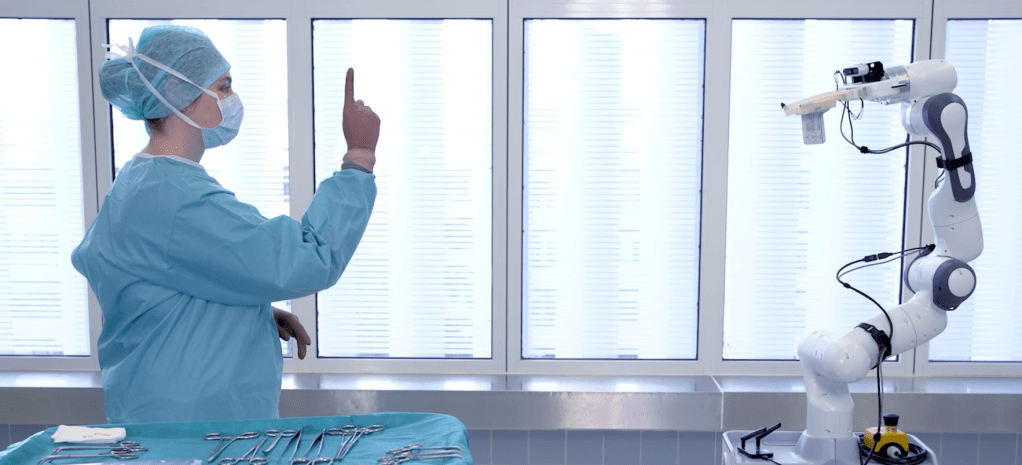
Research Group MITI, TUM University Hospital
Soapbox: Do you have any fascinating do-it-at-home experiments, books, podcasts, or talks that you’d suggest for a good laugh or some interesting insights?
Nina: Since most robots are unfortunately quite expensive, I don’t really have a cool do-it-at-home experiment to recommend. However, I do have a book recommendation. I read it last year, and for me it perfectly captured what doing a PhD can feel like. It was written in a “PhD in a nutshell” way, including the absurdity of academic life. It gave me quite a few good laughs because it felt so relatable: Katabasis, written by R. F. Kuang.
You can connect with Nina on LinkedIn.

