Antennas that Move to Boost Your Signal
– by Amna Irshad

KTH Royal Institute of Technology, Sweden
You are standing on a hill, trying to send a message. One bar. Maybe none.
So, you do what everyone does, you stretch your arm, tilt your phone, and hope for a miracle.
And somehow… at a weird angle … it works.
Now, you’re stuck. You can’t move. You can’t even breathe properly. Because the moment you shift, gone.

No signal, no message, no internet.
We’ve all been there.
What you’re actually doing in that moment is something surprisingly scientific. You’re not just being impatient; you’re helping your phone’s antenna find a better connection.
So, What’s really going on?
Inside your phone are tiny antennas that “talk” to a nearby cell tower (engineers call these base stations). This conversation happens using invisible waves that carry your calls, texts and data.
But here’s the catch: these waves don’t always travel smoothly.
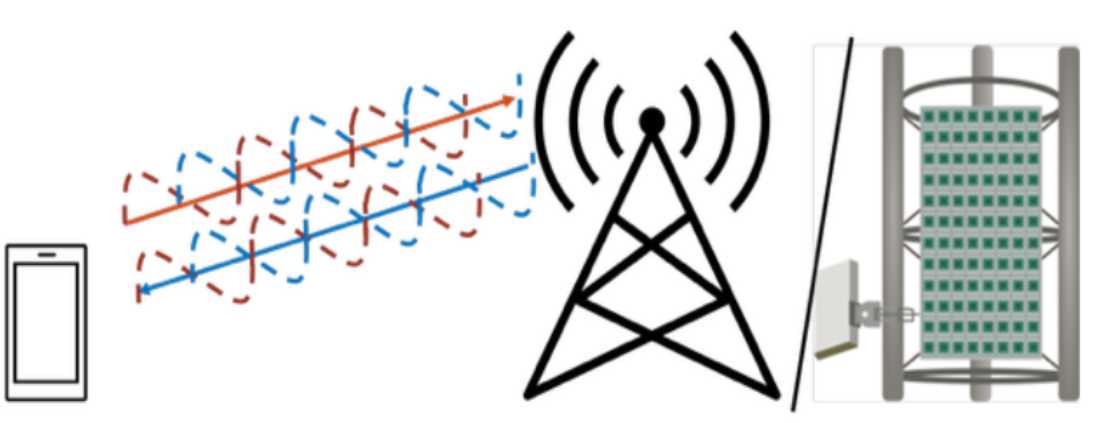
Buildings, hills, trees and even crowds of people can block or scatter them. So, when you move your phone around, you’re actually helping it find a clearer path to the tower, like adjusting a radio antenna to get better sound.
Sometimes, just a small tilt is enough to make the signal stronger. That’s why your “weird angle” trick works.
The Real Limitation
Cell towers are designed to cover specific areas. Engineers carefully place antennas on these towers to serve neighborhoods, streets, and cities.
But once installed, those antennas don’t move.
Your phone, on the other hand, is constantly moving in your pocket, into elevators into crowded spaces, or up on a mountain where signals struggle to reach.
So today, the burden is on you to adjust.
What If the Tower Moves Instead?
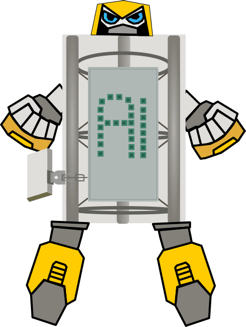
Now imagine this:
Instead of you waving your phone, the tower adjusts itself to find you.
Almost like a Transformer.
This is the real idea researchers are now exploring. These are called as movable antennas or fluid antennas, systems where the antenna positions can change dynamically to improve signal quality.
Think of it like a smart spotlight. Instead of shining in one fixed direction, it shifts and adapts, focusing exactly where it’s needed.
In the future, a tower could quietly adjust its antenna in real time, tracking where users are and optimizing connections automatically. You wouldn’t see giant moving parts like in movies, it could all happen inside compact spaces., but the effect would feel almost magical.
Bad signal in hilly areas? The network adapts.
Crowded concert? The system reconfigures.
No more awkward phone gymnastics.
Where My Research Fits?
This is exactly what I work on in my PhD at the department of communication systems in KTH Royal Institute of Technology, Sweden with my mentors Prof. Emil Bjornson and Prof. Vitaly Petrov.
I study how these “moving antennas” could perform compared to the fixed ones we use today. Can they provide stronger signals? Can they serve more people at once? And how should we arrange them to make sure everyone, not just a few, gets a good connection?
With the rapid development of 5G and the upcoming 6G technologies, these questions are becoming more important than ever. Our world is more connected than before, and expectations are higher. We want fast, reliable internet everywhere.
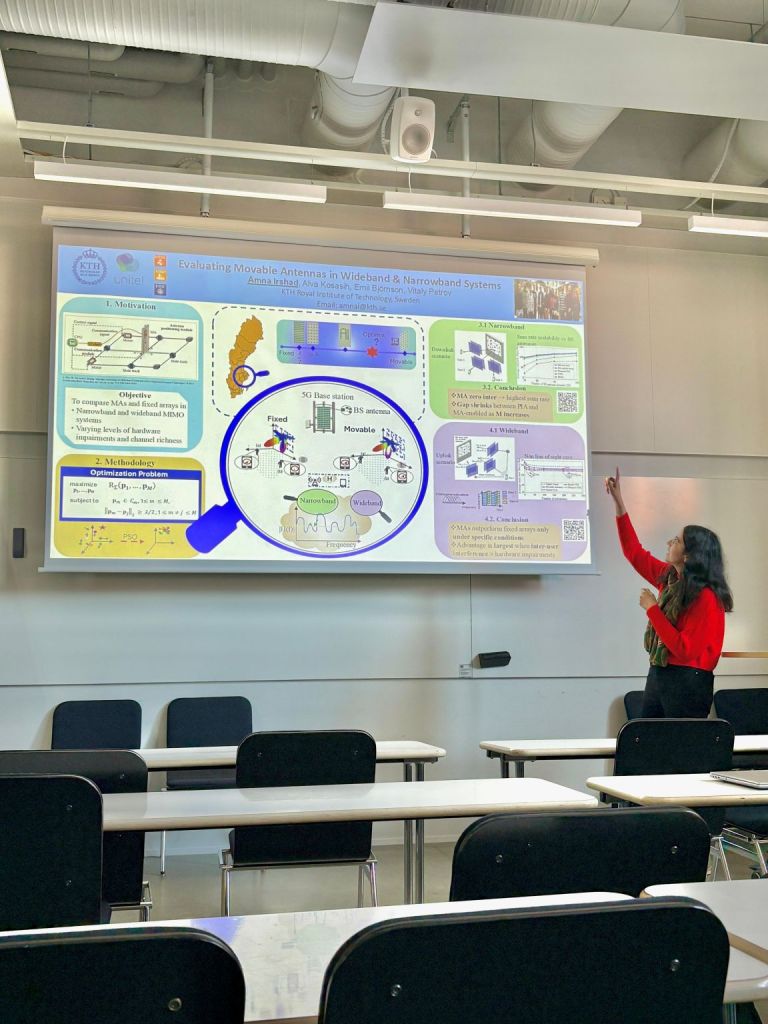
KTH Royal Institute of Technology, Sweden
Even on a hill.
A Small Glimpse into the Future
So, the next time you find yourself holding your phone up in the air, searching for that one precious bar, remember this:
You’re temporarily solving a problem that engineers are trying to eliminate entirely.
One day, you might not need to move at all.
The network will find you.
You can connect with Amna on LinkedIn.

